Coaching, not therapy · Online across the UK
Specialist coaching for male survivors of childhood sexual abuse
What happened was then. But some of it can still show up now. This is specialist one-to-one coaching for adult men who experienced childhood sexual abuse and want to understand how their past may be affecting their relationships, confidence, boundaries, identity, recovery and the way they live today. It isn't therapy, and it isn't about making you repeatedly tell your story. We start with where you are now.
Confidential · Trauma-informed · One-to-one · Online
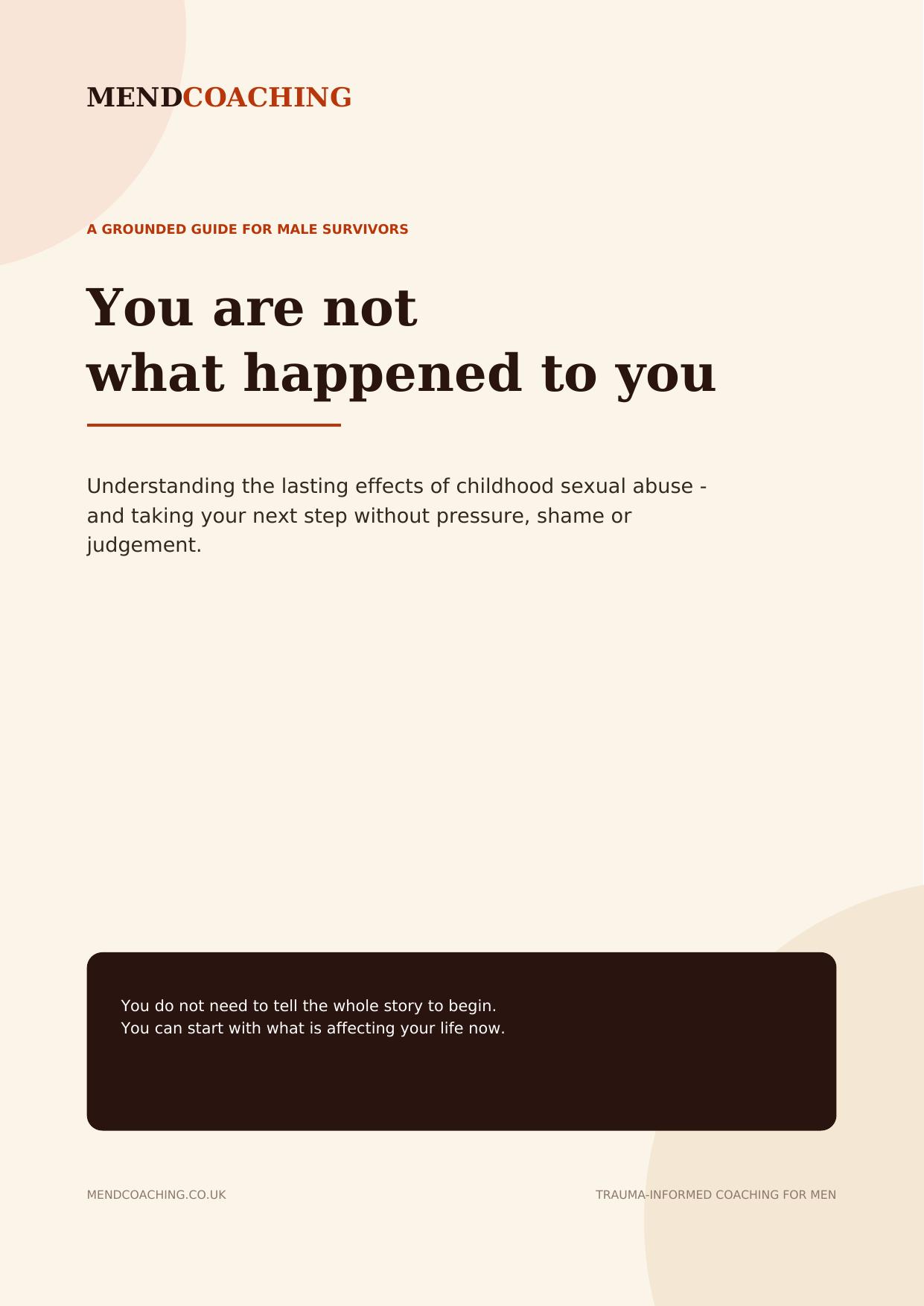
Free 12-page guide
You are not what happened to you
A grounded guide for male survivors, written to help you understand what may still be affecting life now, without pressure to revisit details or use a label that does not feel right.
- Survival patterns and the nervous system
- Grounding tools you can use now
- Shame, boundaries and relationships
- Choosing the right kind of support
PDF guide · Opens immediately
You may recognise some of this
Sometimes it doesn’t look like trauma.
- You struggle to trust people, even when you want connection.
- You feel uncomfortable with emotional or physical intimacy.
- You carry shame that is difficult to explain.
- You find yourself withdrawing when relationships become close.
- You struggle to set or maintain boundaries.
- You feel responsible for other people's emotions.
- You use work, substances, sex, exercise or other behaviours to escape what you feel.
- You experience anger that seems bigger than the situation.
- You find it difficult to know what you actually want.
- You struggle with confidence or self-worth.
- You find fatherhood or relationships bringing unexpected feelings to the surface.
- You have done therapy or recovery work, and still feel there are parts of life you want to change.
You don’t need to identify with all of these. And you don’t need to arrive knowing exactly what you want to work on.
What this is
We work with what’s happening now.
Coaching may involve talking about the past, because the past can be relevant to how life feels today. But the purpose isn’t to recreate, analyse or clinically process traumatic experiences.
The focus is on understanding present-day patterns and developing practical ways forward: what tends to happen, when it happens, what sits underneath it, and what you would like to be different.
Areas men commonly explore here
- Relationships
- Trust
- Intimacy
- Shame
- Confidence
- Boundaries
- Identity
- Anger
- Avoidance
- Fatherhood
- Addiction and recovery
- Connection
- Purpose and direction
You are always in control of what you talk about. You will never be expected to describe the abuse in detail in order to work with me.
Coaching, not therapy
What specialist coaching means.
This service is specialist coaching for adult survivors. It is not psychotherapy, counselling or clinical trauma treatment. We may explore how earlier experiences influence your life today, but I do not provide trauma-processing treatments or ask you to relive traumatic experiences.
Coaching can also sit alongside counselling or psychotherapy where appropriate. If during our initial conversation I believe your needs would be better supported by a therapist or another specialist service, I will tell you. The priority is finding the right support, not simply enrolling you as a client.
The approach
One-to-one, shaped around you
A specialist coaching approach for male survivors of childhood sexual abuse.
This isn’t a rigid programme. Every man arrives with a different life, a different history and a different set of questions, so the shape of the work follows you rather than a template.
- 01
Arrive
Understanding where you are today.
- 02
Notice
Recognising patterns, responses and behaviours.
- 03
Understand
Exploring what may sit underneath them, without judgement.
- 04
Choose
Identifying where you now have choice, boundaries and agency.
- 05
Practise
Turning insight into practical changes.
- 06
Connect
Building healthier relationships with yourself and with others.
- 07
Direction
Deciding how you want the next part of life to look.
Progress is not expected to be linear. Men move back and forth between these, and that’s normal rather than a sign that something has gone wrong.
What a session looks like
A session. No conveyor belt.
Arrive
We begin with what's happening today, rather than immediately going into history. Sometimes that's a situation from the week. Sometimes it's a feeling you can't quite name yet.
Explore
Patterns, relationships, responses and beliefs. Whatever it is you want to understand better or change.
Integrate
We bring it back into your life as it is now, and identify what you want to take away, practise, consider or do differently.
There isn’t a script you have to follow. Some sessions may involve difficult conversations. Others may involve relationships, work, parenting, confidence, exercise, recovery, joy or something seemingly ordinary.
Your life is bigger than what happened to you.
About Jaymes
The person you’d be sitting with
I’m Jaymes Cadby, a specialist coach working one-to-one with men. My practice is informed by professional training, years of frontline work and my own experience.
- CPCAB Level 3 Certificate in Counselling Studies
- Safeguarding training
- Trauma-informed practice training
- Motivational interviewing training
- Extensive frontline experience supporting people through homelessness, addiction and complex life circumstances
- Professional experience within prison and community environments
- Years of personal development and recovery work
- Lived experience of childhood sexual abuse
- Ongoing professional development relevant to trauma-informed practice and supporting adult survivors
“I know how difficult it can be to sit opposite somebody and wonder whether they really understand. My professional experience matters to me. So does my training. But this work is also informed by lived experience. That doesn’t mean our experiences are the same, and I won’t assume I know how you feel. It means you don’t have to convince me that experiences from years ago can still affect life today.”
Who this is for
Adult men, 18 and over.
This coaching is for adult men who experienced sexual abuse in childhood and want support with how it may be affecting life today.
- You do not need to have reported the abuse.
- You do not need a diagnosis.
- You do not need to be in therapy, now or previously.
- You do not need to disclose details of what happened.
When coaching may not be the right support
Sometimes something else is needed first.
Coaching is not an emergency service, a crisis service or a clinical mental health service. There are situations where therapy, medical support, addiction treatment, safeguarding services or another specialist service would be more appropriate, either instead of coaching or alongside it.
If that becomes apparent during our initial conversation, I’ll say so openly, and we’ll talk about what might help instead. Nobody is turned away without a conversation about where else to look.
If you need support right now
Our safeguarding page sets out confidentiality, its limits and the crisis numbers to use if you’re in immediate danger. You may also find Grounding tools and trust & safety useful.
Pricing
Straightforward, and there are Access Places.
Male Survivor Coaching
The complete specialist pathway
£2,000
- Twelve weekly private one-to-one sessions, online
- An individual approach, not a predetermined one
- Practical reflection and tools where appropriate
- Support between sessions, and a review of where you've got to
Twelve weeks is the shape of the work, not a package you have to buy before you know whether we fit. Payment plans are available: the twelve weeks can be split into three instalments, with the first three sessions paid for upfront.
Access Places
Cost should not be the thing that decides whether a man gets support. Alongside the standard pathway there are two Access Places on the programme:
- £1,000A supported place at half the standard cost.
- £0A fully funded place, at no cost.
These are the same programme. Same twelve weeks, same work, same attention. They are not a lesser version and you will not be treated as though you are receiving a favour.
There is no form to fill in and no means test. If cost is the barrier, say so on the free 30-minute call and we will talk about it honestly. Places are limited, so I cannot promise one is open at the moment you ask, but asking costs nothing.
The first conversation
Before you decide anything, let’s talk.
The first step is a free 30-minute private conversation, by video or phone. There is no assessment to pass and no obligation to continue afterwards.
It’s a chance for you to share what you’re looking for, ask whatever you want to ask, and decide whether this feels right. I’ll also be considering whether coaching is appropriate for you, and if I’m not the right person, I will say so.
FAQ
Questions men ask before booking
You don’t have to tell your whole story to start changing what happens next.
If you’re wondering whether this kind of coaching could help, start with a conversation. No commitment. No pressure. No expectation that you disclose anything you’re not ready to discuss.
£2,000 · the complete specialist pathway